Astronomical Unit Calculator: Convert AU to km, Miles & Light Years
Convert astronomical units (AU) to kilometres, miles, light-years, parsecs, and more with this free, easy-to-use Astronomical Unit Calculator.
Use Other Utilities Category Calculators
What Is the Astronomical Unit Calculator?
The Astronomical Unit Calculator is a simple yet powerful online tool designed to convert astronomical units (AU) into commonly used distance units such as kilometres (km), miles (mi), metres (m), light-years (ly), and parsecs (pc). Whether you're a student, an astronomy enthusiast, a teacher, or someone who simply wants to understand the scale of the solar system, this calculator helps you convert between these units instantly and accurately. Just enter a value, select your units, and get precise results in a fraction of a second.
What Is an Astronomical Unit (AU)?
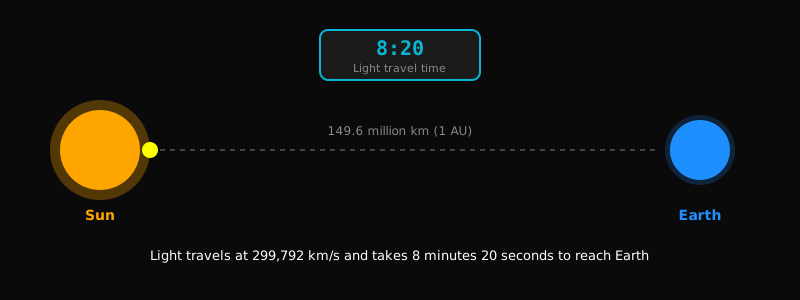
An astronomical unit (AU) is a standard unit of measurement used in astronomy to describe distances within our solar system. It represents the average distance between Earth and the Sun, which the International Astronomical Union (IAU) defines as:
1 AU = 149,597,870,700 metres
(or approximately 149.6 million kilometres)
Why Does the AU Exist?
Distances in space are extremely large, and expressing them in kilometres can become confusing and difficult to visualise. For example:
- Distance from Earth to Mars: ~225 million km
- Distance from Earth to Jupiter: ~778 million km
- Distance from Earth to Pluto: ~5.9 billion km
Instead of saying "778 million kilometres," it's easier to say:
Jupiter is 5.2 AU from the Sun.
The AU provides a practical and intuitive way to compare the distances of planets, asteroids, and spacecraft within the solar system.
Why Understanding AU Helps You Visualise the Solar System
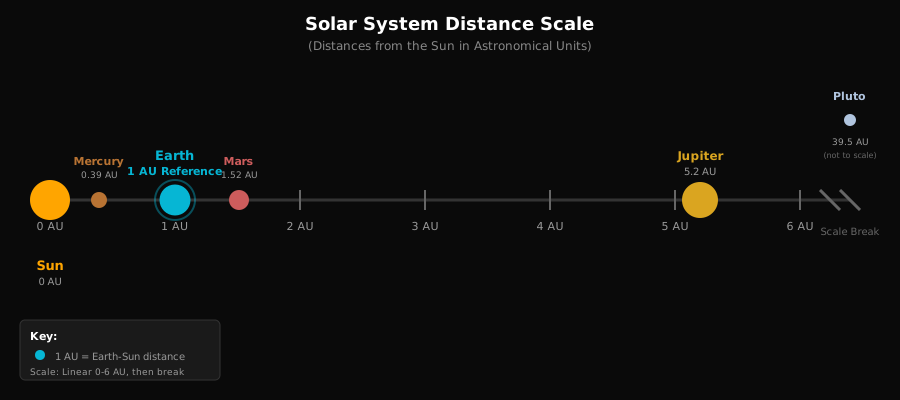
The astronomical unit helps simplify the vastness of space by providing a relatable reference point. Since we know Earth is roughly 1 AU from the Sun, we can imagine:
| Object | Distance from the Sun | In AU |
|---|---|---|
| Mercury | ~58 million km | 0.39 AU |
| Earth | 149.6 million km | 1 AU |
| Mars | ~228 million km | 1.52 AU |
| Jupiter | ~778 million km | 5.2 AU |
| Pluto | ~5.9 billion km | 39.5 AU |
This makes it easier to understand how far each planet lies in comparison to Earth's position.
How to Use the Astronomical Unit Calculator
- Enter the Distance Value: Type the number you want to convert. Examples: 1, 5.2, 1,000,000,000
- Select the "From" Unit: Choose the unit of your input value. Options usually include: AU (Astronomical Unit), km (kilometres), miles, metres, light-years, parsecs
- Select the "To" Unit: Choose the unit you want to convert into. For example: AU → km, km → AU, AU → light-years, AU → parsecs
- View Auto-Conversion: The output appears immediately with accurate values.
- Read, Copy, or Share the Result: You'll see a clear numerical value with the exact unit. The calculator also provides multiple units simultaneously, a formula section, rounded values, and scientific notation mode.
Example Scenarios and Case Studies
Below are practical examples to help you understand how AU conversions work in real life.
Example 1: How Many Kilometres Are in 5 AU?
We know: 1 AU ≈ 149.6 million km
So: 5 AU = 5 × 149.6 million km = 748 million km (approx.)
Explanation: If an object is 5 AU from the Sun, it means it lies roughly 748 million kilometres away, close to Jupiter's orbital distance.
Example 2: Jupiter's Distance from the Sun in Miles
Jupiter is approximately: 5.2 AU from the Sun
Convert AU to miles: 1 AU ≈ 92.96 million miles
So: 5.2 × 92.96 million miles ≈ 483 million miles
Explanation: This helps students or readers convert astronomical distances into everyday units they recognize.
Example 3: A Spacecraft at 1 Billion Kilometres, How Many AU Is That?
Distance given: 1,000,000,000 km
Divide by km per AU: 1 AU = 149.6 million km
1,000,000,000 ÷ 149,600,000 ≈ 6.684 AU
Explanation: If a spacecraft travels 1 billion km from the Sun, it is nearly 6.7 AU away, placing it beyond Jupiter's orbit but before Saturn's (~9.5 AU).
Conversion Formula and Constants
For transparency and scientific accuracy, here are the exact conversion formulas.
1. AU to Metres
Distance (m) = Distance (AU) × 149,597,870,700
2. AU to Kilometres
Distance (km) = Distance (AU) × 149,597,870.7
3. AU to Miles
1 km = 0.621371 miles, So:
Miles = AU × 149,597,870.7 × 0.621371
4. AU to Light-Years
1 light-year ≈ 63,241 AU, Thus:
Light-years = AU ÷ 63,241
5. AU to Parsecs
1 parsec ≈ 206,265 AU, Thus:
Parsecs = AU ÷ 206,265
6. Reverse Conversion (Example: km → AU)
AU = km ÷ 149,597,870.7
These formulas ensure your calculator outputs scientifically accurate values.
The Astronomical Unit Calculator is more than a simple conversion tool—it helps people worldwide understand the incredible scale of our solar system. By converting AU to kilometres, miles, light-years, and parsecs, users gain a clearer, more intuitive picture of distances in space. Whether you're writing a science project, studying astronomy, preparing educational content, or simply exploring the cosmos out of curiosity, this calculator offers accurate, easy, and instant conversions.
References
This calculator uses scientifically verified conversion factors from authoritative sources:
- International Astronomical Union (IAU) – Official definition of the astronomical unit
- NASA Solar System Exploration – Planetary distances and space measurement standards
- Encyclopaedia Britannica – Astronomical unit definition and historical context
Frequently Asked Questions

Amit Kulkarni
Founder & Editor-in-Chief
Software engineer with 7 years of experience building accurate, reliable calculators. Committed to providing expert-verified tools for finance, health, education, and utilities.