Inches to Fraction Calculator: Convert Decimal Inches Easily
Convert decimal inches to fractions instantly. Get accurate fractional inch values like 1/8, 1/16, 1/32 and metric equivalents with this easy calculator.
Enter decimal inches (e.g., 4.375, 2.695, 0.375)
Use Other Utilities Category Calculators
What Is the Inches to Fraction Calculator?
An Inches to Fraction Calculator is a simple online tool that converts decimal inches, like 2.695 in or 0.375 in, into fractional inch values such as 2 11/16 in or 3/8 in. It automates a process that most people find confusing: choosing the correct denominator, rounding properly, and simplifying the resulting fraction.
This calculator is especially useful because most tape measures, rulers, saw guides, carpentry tools, and engineering drawings still show measurements in fractions, not decimals. Instead of manually calculating the nearest 1/16" or 1/32", users can instantly get a precise and usable fractional measurement.
People come to this calculator to:
- Convert a decimal measurement from a digital caliper
- Understand the fractional marking on tape measures
- Convert millimeters to fractional inches
- Simplify DIY, construction, woodworking, and engineering measurements
- Avoid manual fraction math
Overall, the calculator makes measurement conversions fast, accurate, and error-free, especially for a global audience who may not be familiar with the U.S. customary system.
Why Do We Use Fractions in Inches?
The inch-based measurement system, especially within the U.S., is deeply connected to carpentry, construction, metalworking, and other trades. While decimal measurements are more common in scientific and global contexts, fractional inches remain standard in many industries.
Understanding Inch Fractions (1/2, 1/4, 1/8, 1/16, 1/32, 1/64)
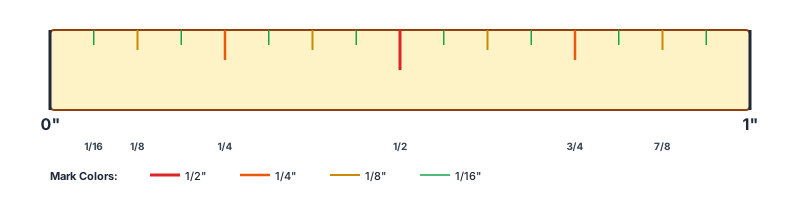
On a tape measure or ruler, an inch is divided into multiple equal parts:
- 1/2" → the inch split into 2 parts
- 1/4" → the inch split into 4 parts
- 1/8" → the inch split into 8 parts
- 1/16" → the inch split into 16 parts
- 1/32" → the inch split into 32 parts
- 1/64" → the inch split into 64 parts
Each step increases precision but also becomes harder to read. Many professional carpenters use up to 1/16", while precision woodworking and machining may require 1/32" or 1/64" accuracy.
Why Fractions Instead of Decimals?
There are three main reasons:
- Traditional tool design: Tools such as tape measures and saw guides were designed before decimal systems became common, and they use fractional markings.
- Practical accuracy: Fractions like 1/16" or 1/32" provide realistic and functional precision in woodworking and carpentry.
- Industry standards: Construction plans, engineering drawings, and woodworking templates still use fractional formats.
Where Fractional Inches Are Used Today
Although the U.S. is the biggest user of fractional inches, they appear in industries across the world:
- Woodworking (America, Canada, Europe, Australia)
- Furniture manufacturing
- Construction tools and hardware
- Home renovation and DIY projects
- Machine parts manufactured to inch standards
- Automobile and aerospace industries using legacy inch-based tooling
How the Calculator Works
Our Inches to Fraction Calculator follows a simple and transparent mathematical process. Here is an easy, beginner-friendly breakdown of what happens behind the scenes.
1. Decimal to Fraction Conversion
Suppose the user enters 2.695 in.
- Separate the whole number: 2
- Take the decimal portion: 0.695
Next, convert the decimal portion into a fraction by multiplying with the chosen denominator:
Example for 1/16":
0.695 × 16 = 11.12
rounded → 11
fraction → 11/16
Final result: 2 11/16"
2. Rounding to the Nearest Fraction
If 0.695 × 16 results in 11.12, rounding gives a clean 11/16. If it had been 11.80, the rounding would move it to 12/16 → 3/4. Rounding removes the guesswork for the user.
3. Simplifying the Fraction
Example: 12/64 becomes 3/16 after simplification. The calculator performs this automatically.
4. Converting to mm and cm
Because many global users rely on the metric system, the calculator also converts:
- Inches → millimeters (1 in = 25.4 mm)
- Inches → centimeters (1 in = 2.54 cm)
This gives users both imperial and metric values in one place.
Example Scenarios
Real-life examples showing how to use the calculator
Example 1: Woodworker measuring 2.695"
A digital caliper shows 2.695 in.
Nearest 1/16": 0.695 × 16 ≈ 11.12 → round to 11 → 2 11/16"
This is the value a carpenter will mark on the wood.
Example 2: Construction worker converting 0.375"
Decimal inch value: 0.375"
Convert to fraction: 0.375 × 8 = 3 → 3/8"
This is a very common measurement in construction (plywood thickness, spacing, pipe fittings).
Example 3: Engineer converting 7 mm to fractional inches
Convert mm → inches: 7 mm ÷ 25.4 ≈ 0.2756 in
Nearest 1/32": 0.2756 × 32 ≈ 8.819 → round to 9 → 9/32"
So, 7 mm ≈ 9/32 inch.
Example 4: Converting 5.12 inches
5.12" = 5 + 0.12
0.12 × 16 ≈ 1.92 → approx 2 → 2/16 = 1/8 → 5 1/8"
Example 5: Converting 1.999 inches
1.999 is almost 2 inches.
Nearest 1/64 → might yield 1 63/64", which simplifies to nearly 2".
Inch Fraction Chart (Decimal → Fraction → mm)
| Decimal (in) | Fraction | mm (approx) |
|---|---|---|
| 0.0625 | 1/16 | 1.59 |
| 0.125 | 1/8 | 3.18 |
| 0.1875 | 3/16 | 4.76 |
| 0.25 | 1/4 | 6.35 |
| 0.3125 | 5/16 | 7.94 |
| 0.375 | 3/8 | 9.53 |
| 0.4375 | 7/16 | 11.11 |
| 0.5 | 1/2 | 12.7 |
| 0.5625 | 9/16 | 14.29 |
| 0.625 | 5/8 | 15.88 |
| 0.6875 | 11/16 | 17.46 |
| 0.75 | 3/4 | 19.05 |
| 0.8125 | 13/16 | 20.64 |
| 0.875 | 7/8 | 22.23 |
| 0.9375 | 15/16 | 23.81 |
| 1.0 | 1 | 25.4 |
Precision & Rounding Options Explained
Choosing the right denominator is critical, depending on your project.
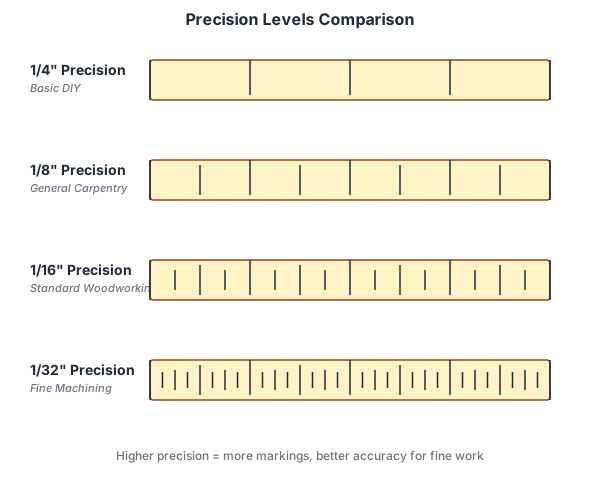
What is 1/16 accuracy?
- Common in general woodworking and DIY
- Most tape measures mark up to 1/16 inch
When should you choose 1/32?
Use this for:
- Furniture making
- Professional carpentry
- Machining
- Fine measurements
Why woodworkers prefer 1/32 or 1/64?
Because small variations matter. A 1/64" error can make cabinets misaligned or joints loose.
Common Fraction Conversions
These are frequently searched conversions online
0.375 → 3/8
0.625 → 5/8
0.4375 → 7/16
0.8125 → 13/16
1.125 → 1 1/8
2.375 → 2 3/8
References
This calculator uses scientifically verified conversion factors from authoritative sources:
- U.S. National Institute of Standards and Technology (NIST) – Inch definitions and conversion factors
- Engineering Toolbox – Decimal/Fraction Equivalents for precision measurements
- ISO Metric Conversion Standards – International measurement system standards
Frequently Asked Questions

Amit Kulkarni
Founder & Editor-in-Chief
Software engineer with 7 years of experience building accurate, reliable calculators. Committed to providing expert-verified tools for finance, health, education, and utilities.