Mesh to Micron Converter: Exact Sieve Size Calculator Online
Instantly convert mesh size to microns (µm) and vice-versa. Free online Mesh to Micron Converter with charts, examples, and simple explanations.
Microns (µm)
149.00 µm
Millimeters (mm)
0.1490 mm
Inches (in)
0.005900 in
Note: This is an approximate conversion – actual size may vary depending on wire diameter, screen construction, and manufacturing tolerances.
Use Other Utilities Category Calculators
Introduction
Our Mesh to Micron Converter is a simple yet powerful online tool designed to help engineers, students, manufacturers, and hobbyists translate mesh sizes into micron values and the other way around. Whether you work with filters, screens, powders, or particle size analysis, this converter eliminates confusion and ensures you get accurate, easy-to-understand results. The goal is to make a complex industrial concept simple enough for anyone, anywhere in the world, to use within seconds.
What Is Mesh?
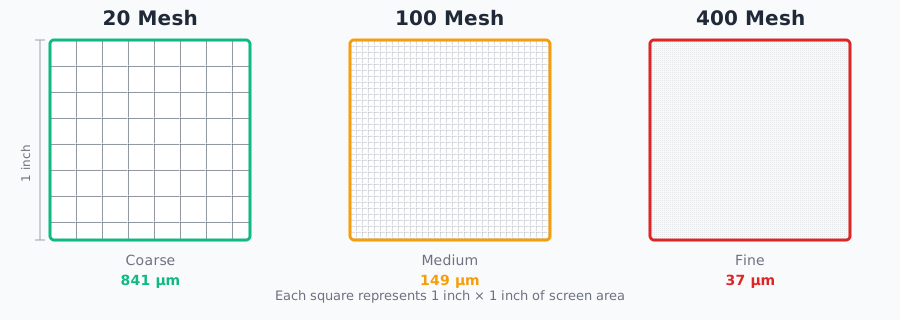
A mesh is a unit that describes the number of openings in a screen or sieve per linear inch. In other words, when you hear "100 mesh," it means the screen has 100 openings in every inch of length.
How mesh originated
Mesh sizing is rooted in old industrial screening practices, widely used in mining, metallurgy, pharmaceuticals, food processing, and material science. Over time, global standards like U.S. Mesh and Tyler Mesh became commonly used, and industries worldwide still rely on them today.
How mesh size works
- Higher mesh number = smaller openings
- Lower mesh number = larger openings
For example:
- 20 mesh → coarse openings
- 200 mesh → fine openings
Where mesh is used
Mesh sizing is used extensively for:
- Powder classification
- Filtration systems
- Soil and sand grading
- Chemical and mineral processing
- Air and water filtration
- Paints, pigments, and coatings
- Agricultural sieving
Understanding mesh size is crucial because it directly influences the size of particles that can pass through a screen.
What Is a Micron (µm)?
A micron, symbolized as µm, is:
- One-millionth of a meter
- One-thousandth of a millimeter
It is used to describe particle size or pore size with high precision. Microns are the standard unit for:
- Air filters
- Water filters
- Powder particle distribution
- Laboratory research
- Industrial material specifications
Examples for context
- Human hair: ~70–100 µm
- Fine beach sand: ~200 µm
- Bacteria: ~1–10 µm
- High-efficiency HEPA filters: ~0.3 µm
The micron scale helps industries ensure quality, consistency, and accuracy in material handling.
Why Convert Between Mesh and Microns?
Many industries list specifications in mesh, while others exclusively use microns. This mismatch often leads to confusion when comparing filters, screens, or powders from different suppliers.
Common industries that require mesh ↔ micron conversion
- Mining and minerals
- Pharmaceuticals
- Chemical engineering
- Food and beverage processing
- Water treatment plants
- Paint and coating manufacturers
- Construction materials
- Agricultural processing
Real-world situations
- A powder supplier may describe product size as "200 mesh," while a lab technician may need the equivalent micron value for analysis.
- A filter manufacturer may specify pore size in microns, but a plant operator only understands mesh sizes.
- Research papers may present particle size distributions in microns, whereas procurement documents list mesh sizes.
A Mesh to Micron Converter bridges this gap by providing a fast, accurate, and approximate translation between these two measurement systems.
How Mesh to Micron Conversion Works
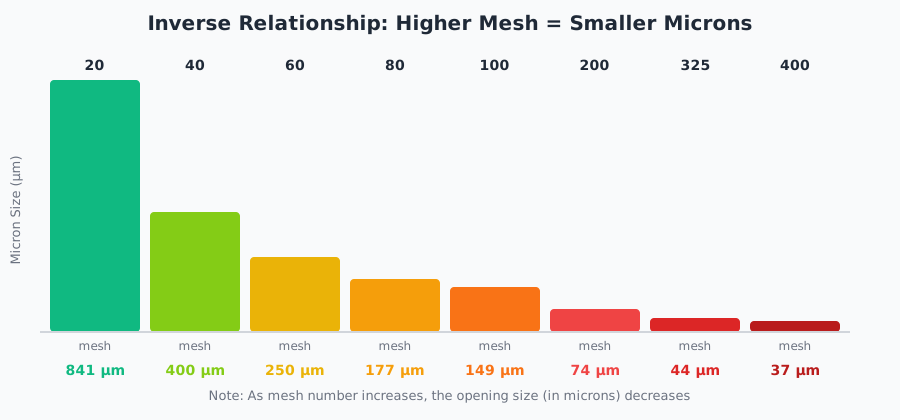
Mesh and micron have an inverse relationship:
Higher mesh number = smaller opening = smaller micron value
This means a 200-mesh screen has finer openings than a 50-mesh screen.
Approximate formula
A widely used approximate formula for standard U.S. Mesh is:
Micron size ≈ 14,900 ÷ Mesh size
This formula is not perfect, but provides a usable estimate.
Why conversions are approximate
Several factors affect accuracy:
- Wire diameter: Thicker wires reduce opening size
- Weave type: Plain weave, twill weave, or welded mesh
- Material expansion: Some metals expand or compress
- Different standards: U.S. Mesh vs. Tyler Mesh vs. ISO sieves
Therefore, all mesh-to-micron conversions are approximations, not exact measurements. Reliable charts and calculators help provide practical working values.
Mesh vs. Micron vs. Millimetres vs. Inches
| Measurement Type | Definition | Example |
|---|---|---|
| Mesh | Openings per linear inch | 100 mesh = 100 openings/inch |
| Micron (µm) | 1 µm = 0.001 mm | 150 µm particle |
| Millimeters (mm) | Metric length unit | 1 mm = 1000 µm |
| Inches (in) | Imperial length unit | 1 inch = 25.4 mm |
Conversion Table
| Mesh | Microns (µm) | Millimeters (mm) | Inches (in) |
|---|---|---|---|
| 20 | 841 | 0.841 | 0.0331 |
| 40 | 400 | 0.4 | 0.0157 |
| 60 | 250 | 0.25 | 0.0098 |
| 80 | 177 | 0.177 | 0.007 |
| 100 | 149 | 0.149 | 0.0058 |
| 200 | 74 | 0.074 | 0.0029 |
| 325 | 44 | 0.044 | 0.0017 |
| 400 | 37 | 0.037 | 0.0014 |
Example Scenarios
Example 1: Powder classification
A ceramics manufacturer buys clay powder labeled "100 mesh," but the factory requires micron specifications.
- Input: 100 mesh
- Output: ≈149 µm
This helps the team adjust machinery for the correct particle size.
Example 2: Filter specification
A filter is rated at 50 µm, but a supplier only provides screens in mesh.
- Input: 50 µm
- Output: ≈297 mesh equivalent (approximate)
The plant operator now knows what mesh size to order.
Example 3: Mining and mineral screening
A metallurgical engineer needs to know the micron size for a 325 mesh sieve used in ore analysis.
- Input: 325 mesh
- Output: ≈44 µm
This value helps determine particle size distribution for processing efficiency.
References
To ensure accuracy and reliability, the converter uses data aligned with standard industrial references, including:
Frequently Asked Questions

Amit Kulkarni
Founder & Editor-in-Chief
Software engineer with 7 years of experience building accurate, reliable calculators. Committed to providing expert-verified tools for finance, health, education, and utilities.