Free Acreage Calculator: Convert Land Area to Acres Easily
Convert land size into acres instantly from square feet, meters, yards, or hectares. Fast, accurate, simple, and global-friendly.
Use Other Utilities Category Calculators
Use our Acreage Calculator to convert land size into acres instantly from square feet, meters, yards, or hectares. Fast, accurate, simple, and global-friendly.
What Is an Acreage Calculator?
An Acreage Calculator is an online tool designed to help you convert the size of land into acres quickly and accurately. Whether you know the land area in square feet, square meters, hectares, or square yards, the calculator instantly converts that value into acres without any manual math.
It's a user-friendly tool built for farmers, real-estate buyers, surveyors, homeowners, developers, and global landowners who need a simple way to determine acreage for land valuation, buying, selling, planning, or farming.
How This Calculator Works
Understanding acreage can be confusing, especially because different countries use different land measurement systems. This section explains the concept of acreage, how the calculator converts values, and why it simplifies a traditionally time-consuming process.
What Is an Acre?
An acre is a globally recognized unit of land measurement, commonly used in the United States, United Kingdom, Canada, Australia, India, Pakistan, and many agricultural economies.
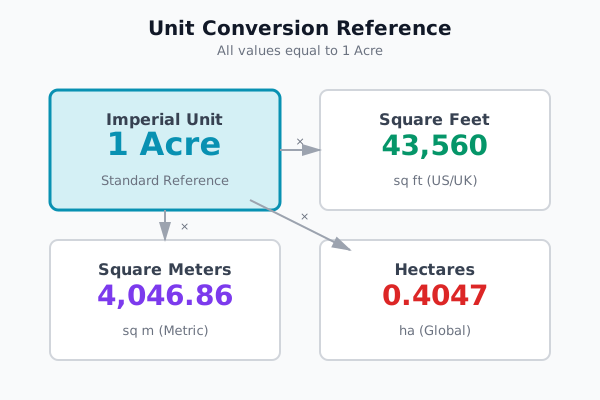
- 1 acre = 43,560 square feet
- 1 acre = 4046.86 square meters
- 1 acre = 0.4047 hectares
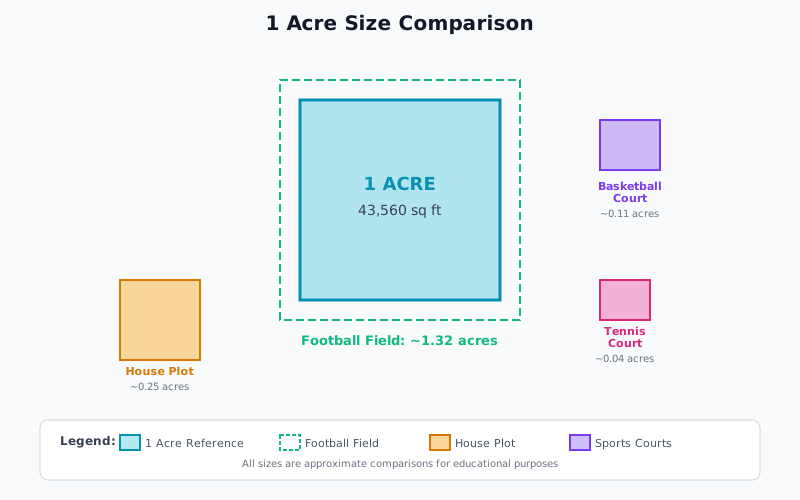
Acre is especially popular because it is easy to visualize and compare with everyday land sizes, such as playgrounds or small sports fields.
Global Relevance of Acres
Even though many countries use the metric system, acres remain widely used in:
- Agriculture (farmland is often measured in acres)
- Real estate transactions (plots and ranches)
- Land surveys & zoning
- Property valuation
- Construction & development
Worldwide search data also shows that millions of people look for "convert square feet to acres" and "acreage calculator" each month, proving how important this unit still is.
Why Converting Acreage Can Be Confusing
Different regions use different units:
- USA → Square feet, acres
- Europe → Square meters, hectares
- India → Bigha, Guntha, Kanal, Marla + Acres
- UK → Acres + Square yards
- Australia → Hectares + Acres
Without a calculator, converting between these units requires formulas that are not easy to remember. For example:
- Converting square feet to acres involves dividing by 43,560
- Converting square meters to acres requires dividing by 4046.856
- Converting hectares to acres means multiplying by 2.47105
For a common user, these calculations are time-consuming and error-prone.
Why an Online Calculator Helps
An acreage calculator:
- •Eliminates manual math
- •Gives instant results
- •Converts between multiple units at once
- •Avoids calculation mistakes
- •Works globally
- •Helps in real estate decision-making
- •Makes land comparison simple and visual
It is especially useful if you are buying or selling land and need fast accurate values before negotiation.
Conversion Formulas for Acreage
Below are the standard formulas used by all professional land surveyors and calculators.
1. Square Feet to Acres Formula
Acres = Square Feet ÷ 43,560
Example: If a plot is 10,000 sq ft, Acres = 10,000 ÷ 43,560 = 0.2296 acres
2. Square Meters to Acres Formula
Acres = Square Meters ÷ 4046.856
Example: If a land area is 2,000 sq m, Acres = 2000 ÷ 4046.856 = 0.494 acres
3. Hectares to Acres Formula
Acres = Hectares × 2.47105
Example: If a farm is 1.5 hectares, Acres = 1.5 × 2.47105 = 3.706 acres
4. Square Yards to Acres Formula
Acres = Square Yards ÷ 4840
Example: If a plot is 2,420 sq yards, Acres = 2420 ÷ 4840 = 0.5 acres
Real-World Example Calculations
Below are three scenarios that reflect real-life land measurement situations across the world.
1. Residential Plot Example
Let's say you're evaluating a plot in a housing layout.
Plot size: 2,400 sq ft
Acres = 2400 ÷ 43,560 = 0.055 acres
So the residential plot is 0.055 acres, or roughly 5.5% of an acre.
2. Agricultural Land Example
A farmer wants to know how many acres a large field covers.
Land area: 8,000 sq meters
Acres = 8000 ÷ 4046.856 = 1.977 acres
So the farmland is approximately 1.98 acres.
3. Irregular Land Shape Example
If a land parcel is not a perfect rectangle, its area is often measured by surveyors in square yards or square meters.
Suppose an irregular plot measures:
Area: 3,000 sq yards
Acres = 3000 ÷ 4840 = 0.619 acres
Even irregular shapes can be converted easily using the calculator, as long as the total area is known.
Real-Life Use Cases: Who Needs an Acreage Calculator?
Acreage calculators are widely used across many industries and professions. Here's how different users benefit:
1. Farmers
Farmers often buy, sell, measure, or lease land by acre. An acreage calculator helps them plan:
- • Crop distribution
- • Irrigation systems
- • Fertilizer usage
- • Land leasing decisions
2. Real Estate Buyers & Sellers
Property transactions frequently quote land sizes in acres. This calculator helps:
- • Compare plot sizes
- • Negotiate prices
- • Understand legal documents
- • Evaluate land values
3. Architects & Construction Professionals
Architects use acreage to design:
- • Building layouts
- • Commercial projects
- • Housing communities
- • Industrial facilities
Knowing exact acreage helps in zoning and planning.
4. Surveyors
Surveyors convert land readings into acres for:
- • Government documentation
- • Land registration
- • Plot mapping
- • Boundary verification
5. Homeowners
Homeowners buying or selling land need to:
- • Verify plot size
- • Estimate landscaping costs
- • Compare prices per acre
- • Plan gardens or extensions
6. Land Developers
Developers depend heavily on acreage to:
- • Calculate saleable area
- • Plan subdivisions
- • Estimate land costs
- • Present land reports to clients
7. Global Land Buyers
Foreign investors or NRIs frequently buy land overseas. An acreage calculator helps them understand measurements in unfamiliar units.
Accuracy Disclaimer & Sources
The acreage values, conversion formulas, and explanations provided on this page are based on internationally recognized measurement standards. While the calculator uses precise formulas, the accuracy of results depends on the accuracy of the user's input.
Sources:
Frequently Asked Questions

Amit Kulkarni
Founder & Editor-in-Chief
Software engineer with 7 years of experience building accurate, reliable calculators. Committed to providing expert-verified tools for finance, health, education, and utilities.