Atom Calculator: Find Protons, Neutrons & Electrons Instantly
Use our free Atom Calculator to quickly determine the number of protons, neutrons, and electrons using atomic number, mass number, or ion charge in seconds.
Use Other Education Category Calculators
What Is This Atom Calculator?
The Atom Calculator is a simple yet powerful online tool that helps you identify the number of protons, neutrons, electrons, and even the ionic charge of any atom or ion. By entering values such as the atomic number (Z), mass number (A), or charge, the calculator instantly computes the fundamental subatomic particle counts.
This calculator is designed for students, teachers, chemistry enthusiasts, and anyone trying to understand the basic building blocks of matter. It provides instant results without requiring manual calculations, formulas, or periodic table memorization.
In modern chemistry, the atomic number and mass number are universally accepted concepts that define the structure of atoms and isotopes. Referencing foundational science principles taught globally in chemistry education, this calculator presents those relationships clearly and accurately.
Example Scenarios (Case Studies)
Below are real-world examples to help you understand how the Atom Calculator interprets inputs and generates outputs.
Example 1: Neutral Sodium Atom (Na)
Given:
- Atomic Number (Z) = 11
- Mass Number (A) = 23
- Charge = 0
Calculation:
- Protons = 11
- Neutrons = 23 – 11 = 12
- Electrons = 11 (equal to protons in neutral atom)
| Property | Value |
|---|---|
| Element | Sodium (Na) |
| Protons | 11 |
| Neutrons | 12 |
| Electrons | 11 |
| Charge | Neutral |
This is the standard atomic structure used in chemistry textbooks and labs.
Example 2: Sulfide Ion (S²⁻)
Given:
- Atomic Number = 16
- Mass Number = 32
- Charge = –2
Calculation:
- Protons = 16
- Neutrons = 32 – 16 = 16
- Electrons = 16 + 2 = 18
| Property | Value |
|---|---|
| Element | Sulfur (S) |
| Protons | 16 |
| Neutrons | 16 |
| Electrons | 18 |
| Charge | –2 (Sulfide ion) |
This clearly shows how ions gain or lose electrons depending on charge.
Example 3: Oxide Ion (O²⁻)
Given:
- Atomic Number = 8
- Mass Number = 16
- Charge = –2
Calculation:
- Protons = 8
- Neutrons = 16 – 8 = 8
- Electrons = 8 + 2 = 10
| Property | Value |
|---|---|
| Element | Oxygen (O) |
| Protons | 8 |
| Neutrons | 8 |
| Electrons | 10 |
| Charge | –2 (Oxide ion) |
Why Use This Atom Calculator Instead of Manual Calculation?
Manually calculating subatomic particles requires remembering various formulas and cross-checking values with the periodic table. Here's why our Atom Calculator is a better alternative:
Accuracy
Manual calculations often lead to mistakes, especially when dealing with isotopes or ions. The calculator eliminates human error.
Speed & Convenience
No need to pull up a periodic table or do subtraction/multiplication manually. Just enter the values and get instant results.
Beginner-Friendly
Even users with minimal chemistry knowledge can use it.
Saves Time During Exams or Assignments
Students can verify answers quickly without wasting minutes on each atom.
Supports Ions & Isotopes Automatically
Advanced calculations become much simpler.
Ideal for Global Users
The interface is simple, mobile-friendly, and avoids jargon. Anyone, anywhere, can use it.
Background Concepts
To fully appreciate the Atom Calculator, here are key concepts explained in plain English:
1. Atomic Number (Z)
- The number of protons in an atom
- Defines which element it is
- Examples: Hydrogen = 1, Carbon = 6, Sodium = 11
2. Mass Number (A)
- Total of protons + neutrons
- Used to find number of neutrons
- Example: Carbon-12 → 6 protons + 6 neutrons
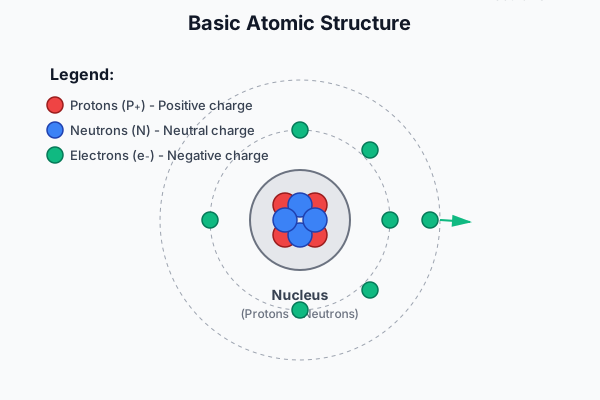
3. Protons
- Positively charged particles in the nucleus
- Determine the identity of the element
4. Neutrons
- Neutral particles in the nucleus
- Influence atomic mass & isotope properties
5. Electrons
- Negatively charged particles around the nucleus
- In neutral atoms → electrons = protons
- In ions → electrons change depending on charge
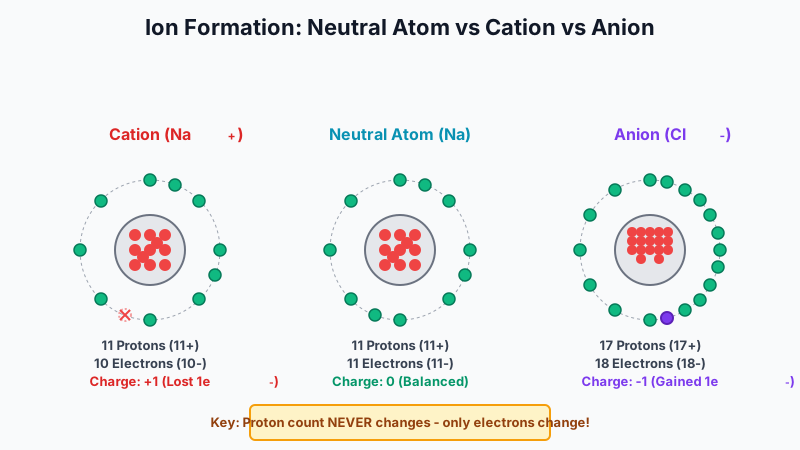
6. Ion Charge
- Atoms become ions when they gain/lose electrons
- Example: Na⁺ = lost 1 electron, Cl⁻ = gained 1 electron
The calculator automates these formulas for you.
References
1. Royal Society of Chemistry - Periodic Table - Comprehensive information on atomic structure and element properties.
2. Khan Academy - Atomic Structure - Educational resource explaining protons, neutrons, electrons, and ions.
3. LibreTexts Chemistry - Atoms and Atomic Theory - Detailed explanation of atomic theory and calculations.
The Atom Calculator is designed to make chemistry simpler, faster, and more accessible for everyone, from high-school learners to university students, educators, and science enthusiasts. With instant calculations and user-friendly design, it removes the complexity of manual atomic structure calculations and delivers accurate results every time.
Frequently Asked Questions (FAQ)

Amit Kulkarni
Founder & Editor-in-Chief
Software engineer with 7 years of experience building accurate, reliable calculators. Committed to providing expert-verified tools for finance, health, education, and utilities.