Lewis Structure Generator: Draw Lewis Dot Diagrams Instantly Online Free
Generate accurate Lewis structures for molecules instantly. Visualize valence electrons, chemical bonds, and lone pairs with our free, easy-to-use educational tool.
Use Other Education Category Calculators
Understanding Lewis Structures
Learning to draw Lewis structures is a fundamental skill in chemistry that helps students visualize how atoms bond together to form molecules. Our Lewis Structure Generator is a free online tool designed to instantly create accurate electron dot diagrams for molecules, showing valence electrons, chemical bonds, and lone pairs in a clear, educational format.
Whether you're a high school chemistry student, college undergraduate, or teacher preparing classroom materials, this generator simplifies a concept many learners find challenging. Supporting 11 common molecules including H₂O, CO₂, NH₃, and more, you can immediately see Lewis structures, understand electron distribution, and learn the principles behind chemical bonding.
What Is This Generator?
The Lewis Structure Generator is an educational tool that automatically draws Lewis dot diagrams (also called electron dot structures) for chemical molecules. Instead of manually counting valence electrons and arranging dots and lines on paper, you get instant, accurate visual representations that follow established chemistry rules.
This tool is perfect for verifying homework answers, studying for chemistry exams, teaching molecular structure concepts, or simply exploring how different atoms combine. Currently supporting 11 molecules (H₂O, CO₂, NH₃, CH₄, O₂, N₂, HCl, CO, H₂S, SO₂, and NO₃⁻), the generator provides detailed information about electron distribution, bonding patterns, and molecular geometry.
What Is a Lewis Structure?
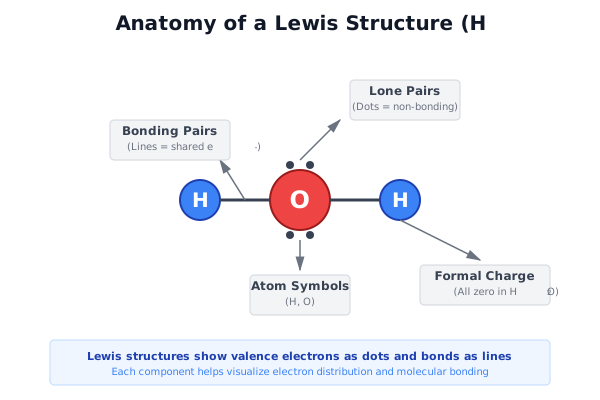
A Lewis structure (named after chemist Gilbert N. Lewis) is a diagram that represents the bonding between atoms in a molecule and the lone pairs of electrons that may exist. These structures use dots to represent valence electrons and lines to represent chemical bonds between atoms.
Key Components:
- Valence Electrons: The electrons in the outermost shell of an atom that participate in chemical bonding
- Bonding Pairs: Pairs of electrons shared between two atoms (represented as lines)
- Lone Pairs: Pairs of valence electrons not involved in bonding (represented as dots)
- Single, Double, Triple Bonds: One, two, or three pairs of shared electrons between atoms
Lewis structures help predict molecular geometry, polarity, and reactivity - essential concepts for understanding chemistry at the molecular level.
Why Do We Draw Lewis Structures?
Lewis structures are more than just diagrams - they are essential tools for understanding chemical behavior:
- Predict Molecular Shape: The arrangement of bonding and lone pairs determines molecular geometry (linear, bent, tetrahedral, etc.)
- Understand Polarity: Lewis structures reveal if a molecule is polar or nonpolar, affecting its physical properties
- Explain Reactivity: Atoms with incomplete octets or formal charges are more reactive
- Visualize Bonding: See how electrons are shared or transferred between atoms
- Compare Resonance Structures: Understand molecules that can be represented by multiple valid structures
- Foundation for VSEPR Theory: Lewis structures are the starting point for predicting 3D molecular shapes
Key Rules for Drawing Lewis Structures
1. Octet Rule
Atoms tend to gain, lose, or share electrons to achieve 8 valence electrons (like noble gases). Exceptions: Hydrogen follows the duet rule (2 electrons).
2. Duet Rule (Hydrogen)
Hydrogen is stable with only 2 valence electrons, so it forms one single bond and has no lone pairs.
3. Central Atom Selection
The least electronegative atom (excluding hydrogen) is typically the central atom. In H₂O, oxygen is central because hydrogen is never central.
4. Electron Pair Distribution
Distribute valence electrons to form bonds first, then place remaining electrons as lone pairs to satisfy octets.
Understanding Formal Charge
Formal charge is a bookkeeping tool to track electron distribution in Lewis structures. It helps determine the most stable arrangement of electrons in a molecule.
Formal Charge = (Valence Electrons) - (Non-bonding Electrons) - ½(Bonding Electrons)
The best Lewis structure typically has formal charges closest to zero, with negative formal charges on more electronegative atoms. For simple molecules like H₂O, formal charges are zero, indicating a stable structure.
How to Use the Lewis Structure Generator
- Step 1: Enter the molecular formula in the input field (e.g., H₂O, H2O, or type "water")
- Step 2: The generator instantly validates your input and displays the Lewis structure if supported
- Step 3: Review the diagram showing atoms (colored circles), bonds (lines), and lone pairs (dots)
- Step 4: Check the electron information box for valence electron count, bonding pairs, and lone pairs
- Step 5: Read the detailed explanation to understand why the structure is drawn that way
- Step 6: Use the share button to create a link for classmates or click reset to try another molecule
Example Scenarios (Case Studies)
Example 1: Water (H₂O) - Currently Supported
Molecular Formula: H₂O
Common Name: Water
Lewis Structure Analysis:
- Total valence electrons: 8 (H: 1×2 + O: 6)
- Central atom: Oxygen
- Bonding pairs: 2 (two O-H single bonds)
- Lone pairs: 2 (on oxygen atom)
- Molecular geometry: Bent (due to lone pair repulsion)
Available in Generator:
You can generate this structure right now using the calculator above!
Example 2: Carbon Dioxide (CO₂) - Coming Soon
Molecular Formula: CO₂
Common Name: Carbon dioxide
Lewis Structure Analysis:
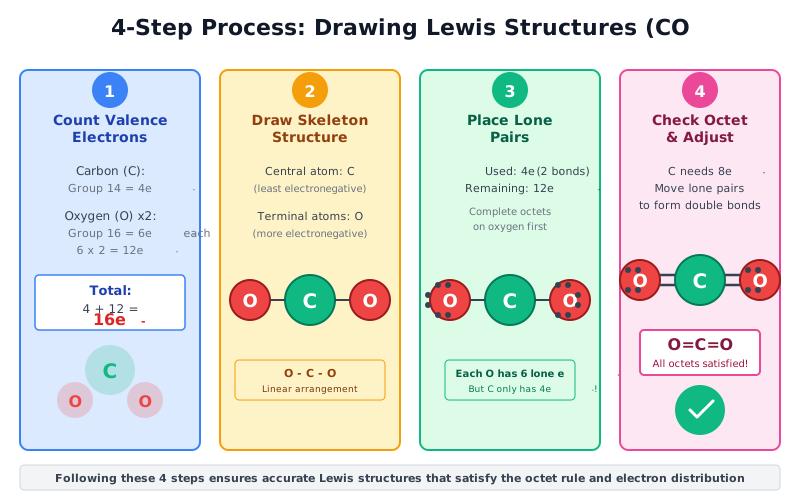
- Total valence electrons: 16 (C: 4 + O: 6×2)
- Central atom: Carbon
- Bonding pairs: 4 (two C=O double bonds)
- Lone pairs: 4 (two on each oxygen)
- Molecular geometry: Linear
Educational Reference:
This structure will be added in the next update. CO₂ demonstrates double bonding and linear geometry.
Example 3: Nitrate Ion (NO₃⁻) - Coming Soon
Molecular Formula: NO₃⁻
Common Name: Nitrate ion
Lewis Structure Analysis:
- Total valence electrons: 24 (N: 5 + O: 6×3 + 1 extra from negative charge)
- Central atom: Nitrogen
- Features resonance structures (3 equivalent forms)
- Formal charge: -1 distributed across the ion
- Molecular geometry: Trigonal planar
Educational Reference:
This polyatomic ion will be added in future updates. It demonstrates resonance and formal charge concepts.
References
- Drawing Lewis Structures - Chemistry LibreTexts - Comprehensive guide to Lewis structure principles and drawing methods.
- Lewis Diagrams - Khan Academy - Educational videos and practice exercises on electron dot structures.
- Lewis Structure - Encyclopaedia Britannica - Authoritative reference on Lewis electron dot diagrams and bonding theory.
Frequently Asked Questions

Amit Kulkarni
Founder & Editor-in-Chief
Software engineer with 7 years of experience building accurate, reliable calculators. Committed to providing expert-verified tools for finance, health, education, and utilities.