Electron Configuration Calculator: Free Tool for All Elements
Instantly calculate the full and shorthand electron configuration of any element or ion. Fast, accurate, and beginner-friendly tool for global learners.
Use Other Education Category Calculators
Understanding Electron Configuration
Understanding how electrons are arranged around an atom plays a crucial role in chemistry, physics, and material science. Our Electron Configuration Calculator is a user-friendly online tool designed to instantly generate the correct electron configuration for any element or ion. Whether you are a student, a teacher, or simply someone curious about how atoms work, this calculator provides accurate results based on standard notation and established scientific rules.
By entering an element's name, symbol, or atomic number, you can quickly determine its electron arrangement, including the full configuration, shorthand noble-gas notation, and valence electron count. This tool simplifies a concept that many learners find confusing, making it easier to study periodic trends, chemical bonding, or atomic structure.
How This Calculator Helps You
The Electron Configuration Calculator is built to make learning and referencing electron configurations simple, instant, and error-free. Instead of manually applying the Aufbau principle, Hund's rule, and Pauli Exclusion Principle, which can be time-consuming and prone to mistakes, you get clear results within seconds.
- Saves Time: Quickly compute complex configurations without memorizing orbital filling sequences.
- Accurate Results: Ensures precision by following scientifically accepted electron-filling rules.
- Helpful for Students & Teachers: Ideal for homework, exam preparation, classroom teaching, chemistry assignments, and lab work.
- Supports Global Users: Accepts inputs in the form of element names, symbols, atomic numbers, or ions with charges.
- Includes Valence Electrons: Displays the number of outer-shell electrons, essential for understanding bonding and reactivity.
- Avoids Common Mistakes: Eliminates confusion around exceptions like copper (Cu) and chromium (Cr), where actual configurations differ from predicted patterns.
What Is Electron Configuration?
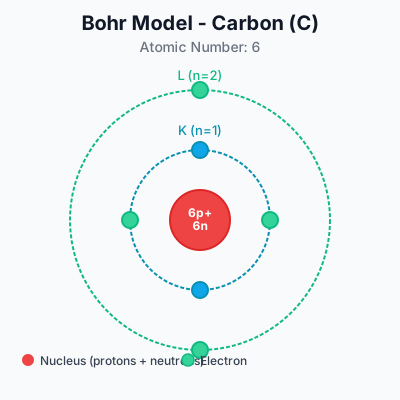
Electron configuration refers to the arrangement of electrons in an atom's orbitals. Every electron occupies a specific energy level (also known as a shell), and each shell contains subshells (s, p, d, f) with a fixed number of orbitals.
Basic Concepts (Explained Simply)
- Shells (Energy Levels): Represented by numbers 1, 2, 3, etc.
- Subshells: Four types: s, p, d, f
- s holds 2 electrons
- p holds 6 electrons
- d holds 10 electrons
- f holds 14 electrons
- Orbitals: Regions where electrons are most likely found.
- Electron Notation: Written as 1s² 2s² 2p⁶, where:
- "1" is the shell
- "s" is the subshell
- "²" is the number of electrons
How Electrons Are Filled
Electron filling follows established rules:
- Aufbau Principle: Electrons occupy the lowest-energy orbital first.
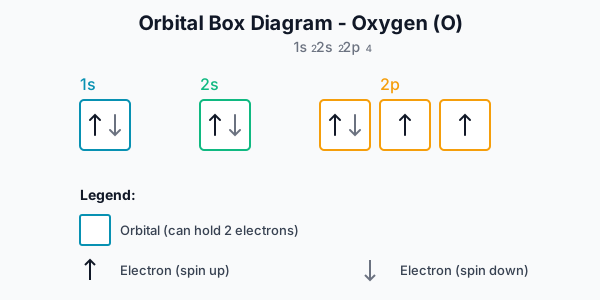
- Pauli Exclusion Principle: An orbital can hold only 2 electrons with opposite spins.
- Hund's Rule: Electrons fill orbitals singly before pairing.
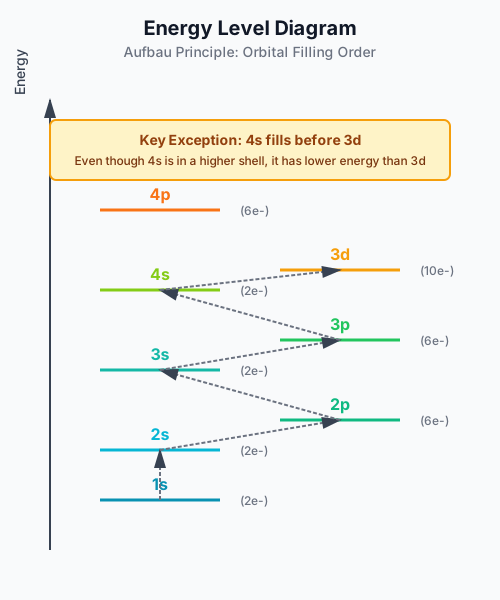
Understanding configurations is essential for predicting chemical behavior, bonding patterns, periodic trends, and the stability of atoms and ions.
Example Scenarios (Case Studies)
Example 1: Oxygen (O)
Atomic Number: 8
Neutral Atom
Full Configuration:
1s² 2s² 2p⁴
Shorthand Configuration:
[He] 2s² 2p⁴
Valence Electrons: 6
Explanation:
Oxygen's electrons fill the 1s, 2s, and then 2p orbitals. Since it has 6 electrons in the outer shell (2s²2p⁴), it is highly reactive and tends to form bonds by gaining 2 electrons.
Example 2: Copper (Cu)
Atomic Number: 29
Neutral Atom
Full Configuration:
1s² 2s² 2p⁶ 3s² 3p⁶ 3d¹⁰ 4s¹
Shorthand Configuration:
[Ar] 4s¹ 3d¹⁰
Valence Electrons: 1 (from 4s¹)
Explanation (Important):
Copper is a famous exception to expected electron filling. You might expect the configuration to be [Ar] 4s² 3d⁹, but electrons rearrange to become more stable by fully filling the d-subshell: [Ar] 4s¹ 3d¹⁰. The calculator automatically accounts for such exceptions.
Example 3: Chloride Ion (Cl⁻)
Atomic Number: 17
Charge: –1 (one extra electron)
Neutral Cl Configuration:
1s² 2s² 2p⁶ 3s² 3p⁵
Chloride Ion (Cl⁻):
1s² 2s² 2p⁶ 3s² 3p⁶
Shorthand:
[Ne] 3s² 3p⁶ = [Ar]
Valence Electrons: 8
Explanation:
By gaining one electron, chloride achieves a stable noble-gas configuration identical to argon.
References
- Electron Configurations - Chemistry LibreTexts - Comprehensive guide to electron configuration principles and rules.
- Electron Configuration - Khan Academy - Educational videos and exercises on atomic structure.
- Electron Configuration - Encyclopaedia Britannica - Authoritative reference on electron arrangement in atoms.
Frequently Asked Questions

Amit Kulkarni
Founder & Editor-in-Chief
Software engineer with 7 years of experience building accurate, reliable calculators. Committed to providing expert-verified tools for finance, health, education, and utilities.